Geometric Seamless Vector Patterns, Geom
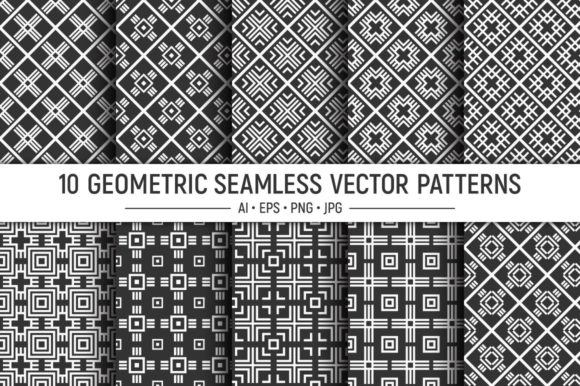
If you’ve ever spent hours trying to tile a background without visible seams—or struggled to scale a design for print without pixelation—you already know the value of truly seamless, vector-based geometry. Geometric Seamless Vector Patterns, Geom solves that problem cleanly and completely: a thoughtfully curated collection of 10 precision-crafted, infinitely scalable patterns built for real-world use—not just aesthetics.
What Makes These Patterns Stand Out?
Not all “seamless” patterns are created equal. Some rely on raster tricks that break at larger sizes; others use low-resolution JPGs or poorly aligned repeats that betray themselves under close inspection. This set avoids those pitfalls entirely. Each of the 10 patterns is:
- Hand-edited for perfect tiling—no ghost lines, no misaligned nodes, no subtle offsets;
- Built natively in Adobe Illustrator using clean vector paths (not traced or auto-generated);
- Optimized for both digital and high-res print: every file delivers crisp output at any scale;
- Delivered in multiple formats—including AI, EPS, JPG, PNG, and transparent PNG—all at 3600×3600px and 300dpi;
- Organized with usability in mind: each pattern lives in its own folder, with swatch panels pre-loaded and a master file containing all 10 for quick access.
The black-and-white palette isn’t a limitation—it’s intentional. High-contrast geometric tiles offer maximum versatility: easy to recolor in seconds, simple to layer over photos or gradients, and inherently legible across devices and contexts. You’re not locked into a trend; you’re equipped with timeless structure.
Where These Patterns Actually Get Used
Designers don’t just download assets—they solve problems. Here’s how professionals apply Geometric Seamless Vector Patterns, Geom day in and day out:
Branding & Marketing Materials
A business card with a subtle hexagonal overlay adds sophistication without overwhelming the logo. A banner for a tech conference uses a clean triangular grid as a backdrop—clean, modern, and fully scalable from social thumbnail to trade show wall. Because these are vectors, your marketing team can drop them straight into InDesign or Canva without worrying about resolution loss—even when repurposing a web graphic for a printed brochure.
Digital Interfaces & Web Design
Web designers use the transparent PNGs as CSS background textures—lightweight, retina-ready, and compatible with modern browsers. The black-and-white base ensures readability over text blocks or interactive elements. One freelance UX designer told us she uses the diamond-pattern variant as a subtle hover-state texture behind navigation items—adding tactile feedback without visual noise.
Product & Packaging Development
Entrepreneurs launching eco-friendly stationery used the linear stripe pattern for kraft paper wrapping—printed at full bleed with zero repeat artifacts. Another client applied the concentric circle motif to fabric labels for a sustainable apparel line, scaling it up to 2m wide on a digital textile printer with zero interpolation or blurring. That’s the power of native vector + true seamlessness.
Educational & Publishing Projects
Teachers building printable worksheets use the dot-grid variant as a subtle writing guide—visible enough to aid spacing, faint enough not to distract. Publishers embedding patterns into ebook chapter dividers appreciate the clean EPS files, which embed reliably in PDF workflows without font or rendering conflicts.
Why Format Variety Matters More Than You Think
Having 10 AI files, 10 EPS files, and 10 of each raster type isn’t overkill—it’s foresight. AI files let you edit anchor points or adjust colors directly in Illustrator. EPS ensures compatibility with older systems or legacy print workflows. JPGs work instantly in PowerPoint or Keynote. PNGs preserve transparency for layered mockups. And the transparent PNGs? They’re indispensable for quick social media posts where you need a textured background behind centered text—no clipping masks required.
The inclusion of swatches is especially practical. Open the AI file, load the swatch panel, and apply any pattern to a shape with one click—no dragging, no resizing, no alignment guesswork. That saves minutes per project, which adds up to hours over a month of client work.
Realistic Considerations Before You Use Them
These patterns shine brightest when treated as foundational tools—not decorative afterthoughts. A few notes from experience:
- Color matters: While black-and-white gives flexibility, avoid applying heavy color overlays that muddy fine details—especially in dense patterns like tessellated triangles. Test contrast ratios if pairing with text.
- Scale intentionally: A small-scale dot grid reads as texture; blown up 300%, it becomes a bold statement. Preview at actual usage size before finalizing.
- Don’t over-compose: Geometric patterns carry visual weight. Pair them with ample whitespace, strong typography, and minimal supporting graphics—let the structure do the work.
- Check your output medium: For screen-only use, JPG or PNG is often sufficient. For commercial print jobs requiring spot colors or Pantone matching, stick with AI or EPS and adjust fills accordingly.
And remember: this is a digital download only. No physical item ships. Mockups shown elsewhere are for illustration only—what you receive are production-ready, editable source files ready for immediate integration into your workflow.
Final Thought: Less Time Searching, More Time Creating
Good design isn’t about having more options—it’s about having the right option, ready when you need it. With Geometric Seamless Vector Patterns, Geom, you’re not adding another folder of unused assets. You’re adding 10 reliable, field-tested foundations—each one built to behave predictably across software, scale, and surface. Whether you're prototyping a landing page, designing packaging for a Kickstarter campaign, or building a consistent visual language for your brand, these patterns remove friction so your ideas land clearly—and professionally.