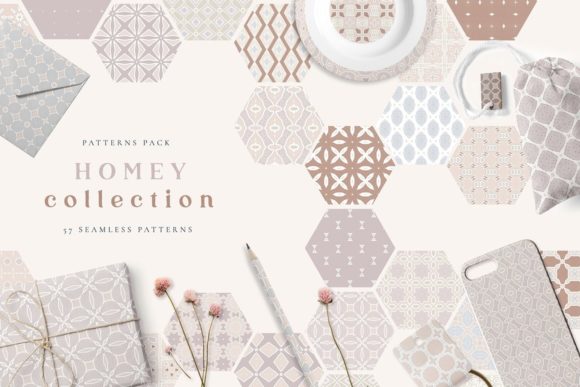
Homey Seamless Patterns: A Practical Resource for Designers and Creators
Homey Seamless Patterns is a curated collection of 57 high-resolution, tileable background designs—each delivered as a 3600×3600 pixel JPG file. Unlike many pattern packs that prioritize trend-driven aesthetics over versatility, this set leans into warmth, subtlety, and quiet cohesion. The name “Homey” isn’t just branding—it reflects the collection’s consistent tone: gentle textures, soft repeats, and organic rhythm. These aren’t bold, graphic motifs meant to dominate; they’re supportive, atmospheric elements designed to ground a design without competing for attention.
What Makes These Patterns Stand Out in Practice?
First, consistency matters—not uniformity. Every pattern shares a restrained color palette (mostly muted earth tones, creamy neutrals, and soft pastels), yet each has distinct character: some suggest hand-drawn linework, others evoke woven textiles or pressed botanicals. That balance avoids visual fatigue when layering or mixing patterns across a project. More importantly, all 57 files are truly seamless—tested at multiple scales and across real-world applications like fabric printing and wallpaper mockups. No visible joins, no awkward offsets, no pixelated edges when tiled. That reliability saves time during production, especially when working under deadlines or with print vendors who require predictable repeat behavior.
The resolution is another practical strength. At 3600×3600 pixels, each file scales cleanly up to large-format prints (e.g., 24″ × 36″ posters or fabric yardage) and down to small digital assets (social media banners, email headers, or app backgrounds). Unlike lower-res PNGs or SVGs that may lack texture depth, these JPGs retain subtle grain and tonal variation—valuable for projects where authenticity matters, such as artisanal branding or wedding stationery.
Real-World Use Cases and Workflow Integration
Homey Seamless Patterns works best when treated as infrastructure—not decoration. For example:
- A small-batch clothing brand used three patterns from the set as base fabrics for linen napkins and matching tote bags. Because the repeats align cleanly across different garment cuts and product dimensions, their production team avoided costly remapping or custom scaling.
- A freelance stationery designer applied one floral-adjacent pattern as a subtle watermark behind invitation text—visible only on close inspection but adding tactile depth to digital proofs and printed pieces alike.
- An educator creating printable classroom resources chose a low-contrast geometric variant for worksheet headers. Its light density kept readability high while giving materials a cohesive, non-distracting identity across dozens of PDFs.
These aren’t edge cases—they reflect how the pack functions in actual workflows: as flexible, production-ready assets that reduce decision fatigue without limiting creative direction. There’s no need to tweak alignment, adjust contrast per use case, or re-export for different outputs. That predictability supports both solo creators managing tight timelines and teams standardizing visual language across touchpoints.
Who Benefits Most—and Where It Falls Short
Homey Seamless Patterns serves professionals who value efficiency, consistency, and understated elegance—particularly those working in lifestyle branding, wedding planning, editorial design, craft-based e-commerce, and educational publishing. Freelancers juggling multiple clients appreciate having a go-to library that reads as intentional rather than generic. Small business owners building their own marketing assets benefit from the lack of licensing friction: no attribution required, no subscription, no usage caps.
That said, it’s not a universal solution. If your work relies heavily on vibrant, high-contrast graphics (e.g., streetwear branding or tech startup visuals), this set may feel too subdued. It also doesn’t include vector versions or editable source files—so designers needing to recolor individual elements or modify motifs will need to work within raster constraints. And while the 57 patterns offer solid variety, they’re not exhaustive: you won’t find metallic foils, photorealistic surfaces, or ultra-minimalist line-only options. This is a focused toolkit, not an encyclopedia.
Quality, Longevity, and Integration Considerations
From a technical standpoint, the files hold up well across platforms. Tested in Adobe Photoshop, Affinity Designer, Figma, and Canva, they import without color shifts or compression artifacts. Their JPG format ensures broad compatibility—even with older CMS templates or email builders that reject layered formats. The absence of transparency means no extra steps when overlaying text or icons, though users needing drop shadows or blending modes should plan for slight adjustments in their editing environment.
Long-term, the value lies in repeatability and tone alignment. Unlike trend-dependent assets that date quickly, these patterns rely on timeless textural cues—soft hatching, irregular dots, gentle crosshatching—that remain relevant across seasons and markets. A café owner using one pattern for seasonal menu boards in spring can reuse the same file for holiday gift tags in December without visual whiplash. That kind of continuity builds brand recognition quietly but effectively.
Practical Recommendations for Getting Started
Start by identifying one recurring need in your current workflow: a background for client proposals, a base layer for social media templates, or a unifying element across packaging variants. Then test two or three Homey Seamless Patterns at that scale and context—observe how they interact with typography, photography, and other graphical elements. Pay attention not just to aesthetics but to performance: does the pattern stay crisp when exported? Does it print without banding? Does it load quickly on web pages?
For teams, consider assigning one pattern per core service or product line—e.g., a warm linen-inspired repeat for consulting deliverables, a delicate leaf motif for wellness offerings. That creates instant visual hierarchy without requiring custom illustration. And if you're sourcing for print-on-demand partners (like Spoonflower or Printful), verify their recommended DPI and bleed settings first—the 3600×3600 resolution covers most requirements, but double-checking prevents last-minute rescaling.
Finally, treat the set as a starting point—not a finish line. These patterns respond well to subtle layering (e.g., lowering opacity over photos), duotone overlays, or cropping into custom shapes for stickers or icons. Their strength isn’t in standing alone, but in supporting stronger ideas with quiet confidence.
Homey Seamless Patterns delivers what it promises: dependable, warm, and thoughtfully constructed backgrounds that integrate smoothly into diverse creative workflows. It won’t replace custom illustration or solve complex brand strategy—but for anyone building tangible, human-centered design across physical and digital spaces, it’s a quietly effective resource worth keeping within reach.