Kids Seamless Patterns 2: Thoughtful Design Tools for Modern Creative Workflows
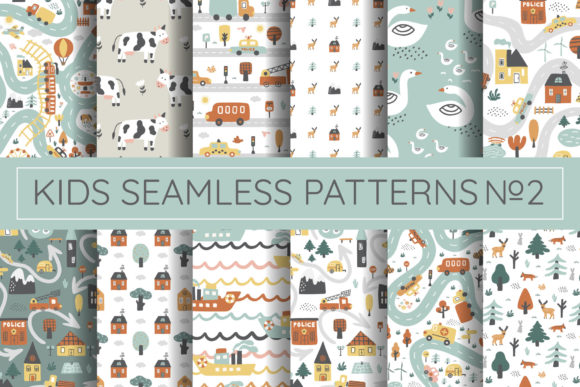
Designing for children’s spaces and products has shifted from playful improvisation to intentional, values-driven practice—and Kids Seamless Patterns 2 reflects that evolution. This curated collection of 12 seamless patterns—delivered in EPS, PNG, and JPEG formats—was built not just for visual appeal, but for real-world flexibility across wallpaper, nursery décor, textiles, and apparel prints. What sets it apart is its cohesive pastel color palette: soft sage, whisper-blue, oat-milk beige, blush rose, and muted lavender—not neon-bright or overly saturated, but grounded, breathable, and inclusive in tone. These aren’t “babyish” colors; they’re designed to age with a child, support calm environments, and align with contemporary aesthetics favored by interior designers, indie makers, and sustainable brands.
Why Seamless Patterns Matter More Than Ever
Seamless patterns are no longer niche assets—they’re infrastructure. With rising demand for custom-printed fabrics, wallcoverings, and limited-run apparel, professionals need repeatable, resolution-independent designs that scale without distortion or visible joins. Kids Seamless Patterns 2 delivers exactly that: vector-based EPS files for infinite scalability, high-res PNGs for digital mockups and web use, and JPEGs for quick integration into presentations or client previews. Unlike one-off illustrations or raster-only bundles, this set prioritizes production readiness. A textile designer can drop an EPS directly into Adobe Illustrator and adjust tile size for quilting cotton or organic jersey. A small-batch apparel brand can export a PNG at 300 DPI for DTG printing on toddler rompers—no reworking required.
This practicality responds to two parallel shifts: first, the growth of print-on-demand (POD) platforms that reward clean, well-structured assets; second, tighter project timelines across freelance and in-house creative roles. Waiting for custom pattern development—or wrestling with misaligned repeats—adds friction. Having 12 professionally crafted, tested, and harmonized options means faster iteration, fewer revisions, and more time spent on storytelling, branding, or user experience—not technical troubleshooting.
Pastel Palettes Are Evolving Beyond Stereotypes
Pastels have long been associated with infancy—but today’s interpretation is more nuanced. The pastel color palette in Kids Seamless Patterns 2 avoids gender-coded assumptions (no “blue for boys, pink for girls”) and instead leans into sensory-aware design principles. Soft tones reduce visual noise, supporting focus in learning environments and lowering stimulation in nurseries—a consideration increasingly cited by pediatric occupational therapists and early childhood educators. That same calmness translates to apparel: parents now seek clothing that feels gentle on skin *and* sight—think breathable cotton onesies printed with a subtle leaf-and-cloud repeat in mist-gray and oat, rather than bold cartoon motifs.
Market data supports this shift: home décor retailers report double-digit growth in “quiet luxury” nursery collections, while independent fabric shops note stronger sales in low-contrast, nature-inspired prints. Even commercial clients—like daycare centers updating their interiors—are specifying non-distracting wall patterns that support emotional regulation. Kids Seamless Patterns 2 meets that need without sacrificing charm: its motifs include stylized rainbows, nesting birds, tiny stars, abstract clouds, and botanical silhouettes—all arranged with generous negative space and balanced rhythm.
From Wallpaper to Wardrobe: Real-World Applications
The versatility of these patterns isn’t theoretical—it’s baked into how creators actually work. Consider three examples:
- A freelance interior designer uses the “Cloud Drift” pattern (a gentle, asymmetrical repeat in sky-blue and dove-gray) as wallpaper for a Montessori classroom reading nook—printed on non-woven, peel-and-stick material for easy installation and future removal.
- A children’s book illustrator licenses the “Tiny Bloom” motif to a sustainable apparel startup, which prints it on GOTS-certified bamboo-cotton blend leggings. Because the pattern is truly seamless and provided in multiple file types, the manufacturer avoids costly color-shift corrections during prepress.
- An educator building a sensory-friendly homeschool space downloads the “Starlight Dot” JPEG, layers it subtly behind educational posters in Canva, and projects it onto a ceiling using a low-lumen projector for calming bedtime routines.
Each use case relies on the same foundational strengths: format diversity, color consistency across outputs, and intentional spacing between elements. There’s no “filler” in the set—every pattern serves a distinct functional or emotional purpose, whether it’s encouraging visual tracking in infants (“Wandering Line”) or offering quiet texture for older toddlers (“Linen Weave Soft”).
How Technology Is Changing Pattern Use—And Why File Choice Matters
Today’s creative tools expect flexibility. Designers using Figma or Sketch rely on PNGs with transparent backgrounds for rapid UI mockups of baby product packaging. Those working in Procreate or Affinity Designer often prefer layered PNGs for texture blending. Meanwhile, production teams still require EPS or SVG for cutting machines, embroidery digitizing, or large-format printing. Kids Seamless Patterns 2 anticipates these workflows—not by overloading with 20 file variants, but by delivering the three most widely supported, interoperable formats, each optimized for its role.
This approach respects both technical constraints and cognitive load. A busy entrepreneur launching a line of organic swaddles doesn’t need to learn vector editing just to resize a pattern—they can use the JPEG at exact print dimensions, confident the repeat aligns. Likewise, a marketing manager preparing social assets can drag a PNG into CapCut or Premiere Rush and apply subtle opacity or blur for background overlays—no risk of pixelation or jagged edges.
Supporting Ethical and Inclusive Creative Practice
Behind every pattern in Kids Seamless Patterns 2 is a commitment to responsible creation. Motifs avoid cultural appropriation, steer clear of stereotyped animal portrayals (no exaggerated grins or anthropomorphized predators), and prioritize positive, open-ended symbolism—like interconnected circles representing community, or branching lines suggesting growth. The pastel palette itself supports accessibility: sufficient contrast between elements and background ensures readability for users with mild visual processing differences, and the absence of vibrating color combinations reduces seizure risk for photosensitive individuals.
That attention extends to licensing clarity. Each pattern is delivered with straightforward usage rights—covering commercial applications like physical products, digital templates, and client work—without restrictive clauses about minimum order volumes or mandatory attribution. For freelancers juggling multiple clients, or educators adapting materials for diverse learners, that transparency eliminates guesswork and legal hesitation.
What Comes Next—Without Overpromising
Patterns won’t replace thoughtful design—but they can elevate it. As AI-assisted tools grow more capable of generating *variations*, the value of human-curated, context-aware assets like Kids Seamless Patterns 2 increases. Why? Because algorithms still struggle with intentionality: knowing when a cloud should float higher in the repeat to avoid visual heaviness, or how much space a toddler’s eye needs between shapes to track comfortably. These subtleties emerge from observation, not computation.
Looking ahead, we expect continued demand for pattern libraries that serve specific life stages—not just “kids,” but “0–3,” “4–7,” and “8–12”—with corresponding shifts in scale, complexity, and emotional resonance. Kids Seamless Patterns 2 sits firmly in that early childhood sweet spot: simple enough for infant engagement, rich enough for preschool exploration, and refined enough for adult-led spaces where beauty and function coexist.
If you’re selecting patterns for a project—whether it’s lining a diaper bag, wrapping a baby shower gift, or designing a pediatric clinic waiting area—ask not just “Does this look nice?” but “Does this support how people will interact with it?” That’s where Kids Seamless Patterns 2 earns its place: not as decoration, but as considered, reusable, quietly capable design infrastructure.