Repeat Botanical Patterns: A Practical Guide for Designers and Makers
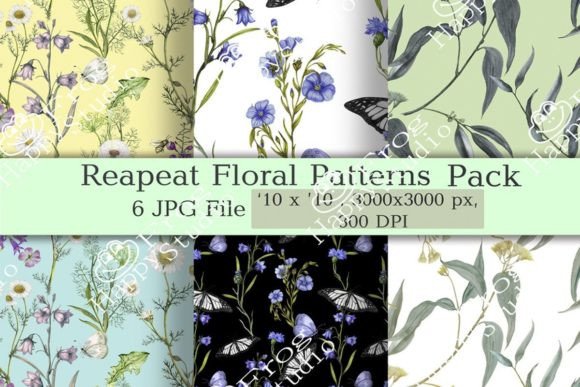
Repeat Botanical Patterns is a curated set of six high-resolution, hand-drawn seamless botanical patterns—designed specifically for versatility across physical and digital applications. Each pattern is delivered as a JPG file measuring 3000×3000 pixels at 300 DPI, with a scalable 10×10 inch base dimension. Unlike algorithmically generated or vector-based repeats, these patterns emphasize organic line work, subtle texture, and natural variation in leaf shape, stem curvature, and floral density—qualities that reflect deliberate hand-drawing rather than digital uniformity.
What Makes Repeat Botanical Patterns Distinct
Their distinction lies not in novelty alone, but in execution fidelity and intentional design constraints. Because they’re hand-drawn—not traced, not AI-assisted, and not built from clipart elements—each pattern carries slight irregularities: a slightly uneven petal edge, a stem that bends just beyond strict symmetry, or a cluster of leaves that avoids pixel-perfect repetition. These imperfections are assets in contexts where warmth and authenticity matter: artisanal packaging, boutique stationery, small-batch fabric printing, or editorial layouts seeking visual tactility.
Seamlessness is technically robust—tested across tile-based workflows in Adobe Photoshop, Illustrator, and Affinity Designer—but the repeat logic prioritizes rhythm over rigidity. For example, one pattern may feature climbing vines that interlock diagonally, while another uses clustered blossoms spaced to avoid visual monotony when tiled at scale. This contrasts with many mass-produced seamless patterns that rely on mirrored or grid-aligned motifs, which can feel predictable when scaled up on large surfaces like wallpaper or textile yardage.
How It Compares Across Common Pattern Formats
When evaluating pattern resources, format and origin significantly affect usability. Repeat Botanical Patterns sits between two common categories: vector-based botanical packs (often sold as SVG or AI files) and photorealistic texture overlays (like scanned pressed-flower composites).
- Vector patterns offer infinite scalability and easy color adjustment, but often lack the nuanced weight and grain of ink-on-paper drawing. They’re ideal for logos or single-color screen printing—but less suited for projects needing tonal subtlety or textural depth.
- Photographic botanical textures provide realism and lighting nuance, yet rarely tile seamlessly without visible seams or lighting mismatches. They also tend to be larger in file size and less flexible for color replacement in print production.
- Repeat Botanical Patterns occupy a middle ground: raster-based for fidelity to original linework, high-resolution enough for print, and carefully constructed to eliminate seam visibility—even at full bleed on a 24×36 inch poster or fabric swatch.
This makes them especially useful when working within tight production timelines where editing flexibility matters less than immediate usability. You don’t need to adjust anchor points or rebuild paths—you open the file, place it, and scale it confidently.
Real-World Use Cases and Practical Fit
Designers choosing Repeat Botanical Patterns typically do so for specific workflow needs—not general-purpose decoration. Here’s where the set delivers tangible value:
- Fabric and surface design: The 3000×3000 px resolution supports standard textile print services (e.g., Spoonflower, Contrado) without upscaling artifacts. Test prints on cotton poplin or silk twill show clean line definition and consistent repeat alignment.
- Packaging and stationery: Because each pattern is delivered as a flat JPG—not layered PSDs or multi-color separations—it integrates quickly into dieline templates. Greeting cards, gift wrap, or product boxes benefit from the cohesive, non-distracting rhythm of the repeats.
- Digital backgrounds and UI elements: While not retina-optimized at 2× scale by default, the resolution holds well on desktop web layouts and tablet-sized interfaces. Used as subtle hero section backdrops or notebook app textures, they add botanical character without competing with foreground content.
Conversely, if your project requires precise Pantone matching, spot-color separation for silkscreening, or animated pattern transitions (e.g., for web banners), Repeat Botanical Patterns won’t fulfill those needs natively. Those scenarios call for vector sources or custom-built assets—not pre-rendered JPGs.
Tradeoffs to Consider Before Choosing
No pattern resource fits every use case—and understanding the tradeoffs helps avoid misalignment later in production.
Color flexibility is limited. As JPGs, the patterns are flattened and RGB-only. You can recolor them using blending modes or channel adjustments in Photoshop, but exact CMYK conversion or Pantone simulation requires additional calibration—and may shift perceived contrast or saturation. If your brand guidelines mandate strict color control across media, consider whether this set supports your output pipeline.
Scalability has practical boundaries. Though 3000×3000 px works well up to ~24-inch prints at 150 DPI, pushing beyond that—say, for a 6-foot mural—may reveal pixel-level softness unless upscaled with AI tools (which introduce their own artifacts). Vector alternatives remain preferable for architectural-scale applications.
Style consistency is intentional—but narrow. All six patterns share a unified hand-drawn aesthetic: fine ink lines, light negative space, and restrained botanical variety (mostly eucalyptus, ferns, trailing ivy, and simple blossoms). That cohesion is a strength for branding continuity—but limits stylistic range. If you need contrasting moods—e.g., bold tropical, delicate Japanese maple, or abstracted botanical minimalism—you’d need to supplement with other resources.
When Repeat Botanical Patterns Is the Right Choice
This set shines when your priority is speed, authenticity, and tactile appeal—not maximal customization. It’s well-suited for:
- Small creative businesses launching seasonal product lines (e.g., spring-themed notebooks, wedding stationery suites, or limited-run apparel) who need polished, cohesive visuals without hiring an illustrator.
- Graphic designers building brand collateral for wellness, herbal, or slow-living clients—where botanical motifs signal values like care, growth, and natural rhythm.
- Educators or workshop facilitators creating printable resources (lesson plans, journal prompts, classroom posters) that benefit from calming, nature-derived backgrounds.
In each case, the value isn’t just visual—it’s time saved in asset sourcing, reduced risk of licensing complications (all files are royalty-free for commercial use), and consistency across touchpoints without needing to manage multiple style guides.
When Another Option May Be Better
If your work demands frequent color iteration across dozens of variants—or if you’re developing a long-term brand system requiring scalable, editable assets—vector-based botanical pattern libraries may offer more sustainable flexibility. Similarly, if your audience engages primarily via mobile interfaces where performance and responsive scaling are critical, lightweight SVG repeats or CSS-generated patterns could reduce load times and improve accessibility.
And if historical accuracy, scientific precision, or regional botanical specificity matters (e.g., native plant illustrations for conservation materials), hand-drawn doesn’t automatically mean authoritative—consulting botanical illustrators or herbarium archives remains essential.
Ultimately, Repeat Botanical Patterns serves a clear niche: designers and makers who value human-made texture, need reliable seamless behavior, and prefer ready-to-use quality over endless tweaking. It doesn’t replace illustration, photography, or coding—but it fills a pragmatic gap between concept and execution, quietly supporting thoughtful design without demanding attention.