Seamless Patterns with Crossed Knight Swords: Design Intelligence for Modern Fabric and Digital Applications
At the intersection of historical resonance and contemporary production efficiency lies a quietly transformative design resource: the Set of Seamless Patterns with Crossed Knight Swords. More than decorative motifs, these vector-based ornaments embody a convergence of craftsmanship, scalability, and narrative intentionality—making them indispensable for professionals who design for print, apparel, branding, and immersive digital experiences. Unlike static illustrations or one-off icons, this set delivers algorithmically coherent repetition: each tile aligns perfectly at its edges, enabling infinite tiling across fabric rolls, website backgrounds, packaging substrates, or AR surface mapping—without visible seams, distortion, or manual retouching.
What Exactly Is a Set of Seamless Patterns with Crossed Knight Swords?
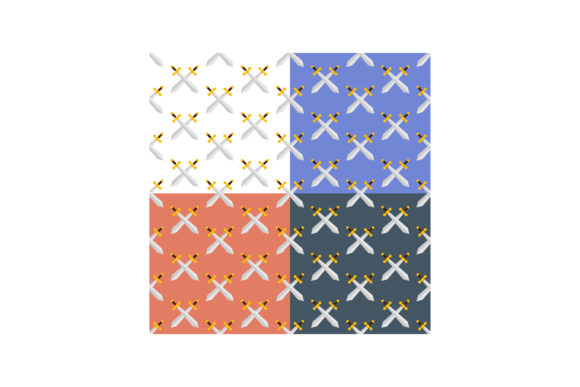
A Set of Seamless Patterns with Crossed Knight Swords is a curated collection of vector graphics in which stylized, historically informed knight swords intersect dynamically—often at diagonal or symmetrical angles—within a repeatable tile structure. “Crossed” here denotes intentional compositional tension: blades overlapping, crossing at guard or hilt, sometimes entwined with heraldic flourishes, chainmail textures, or subtle medieval typography. “Seamless” refers to technical precision: each pattern’s left edge matches its right, and its top aligns flawlessly with its bottom—enabling continuous, scalable application without visual interruption.
These are not clipart repurposings or raster scans of antique engravings. They are built natively in vector environments (e.g., Adobe Illustrator or Affinity Designer), using parametric paths, global swatches, and non-destructive effects—ensuring crisp rendering at any size, from embroidery stitch files (0.5 mm detail) to billboard-scale textile murals (3 m × 5 m). Each pattern in the set typically includes multiple variants: monochrome line work, tonal halftones, distressed overlays, and colorways optimized for dye-sublimation, screen printing, or direct-to-garment workflows.
Why This Pattern Type Is Gaining Strategic Relevance
Three converging forces explain rising demand for the Set of Seamless Patterns with Crossed Knight Swords:
- Resurgence of Narrative Texture in Brand Identity: Consumers increasingly associate authenticity with layered meaning—not just aesthetics. A crossed-sword motif subtly signals values like honor, readiness, duality (offense/defense), or tradition-in-motion. Brands in premium apparel, tabletop gaming, luxury stationery, and even fintech security platforms leverage such symbolism—not as literal iconography, but as embedded semiotic texture. When applied across a capsule collection’s fabric lining, packaging foil stamp, and app onboarding animation, the pattern becomes a quiet throughline of brand language.
- Acceleration of On-Demand Production Systems: Print-on-demand (POD), roll-to-roll digital textile printing, and AI-assisted pattern customization tools require assets that are resolution-agnostic, editable in real time, and compatible with automated layout engines. Raster-based repeats fail at scale; hand-drawn repeats introduce alignment drift. Vector-based seamless patterns eliminate those bottlenecks. A designer can adjust stroke weight globally, swap Pantone swatches via script, or generate 200 unique variants from one master tile—all within minutes.
- Convergence of Physical and Digital Surface Design: As spatial computing advances, surfaces—whether woven cotton, ceramic tile, or VR environment geometry—are no longer treated as isolated canvases. The same crossed-knight-sword pattern may appear as jacquard weave on a limited-edition jacket, then reprojected as dynamic parallax layer in a brand’s WebXR experience. Vector seamlessness ensures fidelity across these contexts without asset fragmentation or redundant recreation.
Practical Integration Across Creative Workflows
Professionals aren’t adopting these patterns as stylistic novelties—they’re embedding them into operational infrastructure:
- For Textile Designers: A fashion house launching a heritage-inspired menswear line used a Set of Seamless Patterns with Crossed Knight Swords to develop coordinated shirting fabrics, pocket linings, and scarf borders—all derived from a single vector tile. By adjusting spacing and contrast in the base file, they generated six distinct weights (subtle tone-on-tone to high-contrast black-on-ivory), reducing development time by 65% versus commissioning individual prints.
- For Brand Strategists: A tabletop RPG publisher licensed a customizable version of the set to empower community creators. Using a lightweight web tool, fans could select blade style, background density, and accent color—then download production-ready PDF/X-4 files for local print shops. This turned passive consumers into co-creators while maintaining brand integrity at the vector level.
- For UX/UI Designers: A cybersecurity SaaS platform integrated a low-opacity variant of the pattern as a subtle animated background in its admin dashboard. The crossed swords—rendered in muted steel gray—evoked vigilance and structural integrity without triggering aggressive connotations. Because the pattern was SVG-based and CSS-repeatable, it loaded in under 2 KB and scaled responsively across tablet kiosks and ultra-wide monitors alike.
Technical Rigor Meets Cultural Resonance
The enduring appeal of crossed weaponry in ornamentation isn’t accidental—it reflects deep-seated cognitive preferences. Crossed forms create stable visual anchors; diagonals imply motion and readiness; medieval iconography carries built-in recognition without requiring explanation. But modern execution avoids pastiche. Today’s leading sets use restrained linework, balanced negative space, and modular construction—so the swords read as design elements first, historical references second.
This balance is critical for global deployment. A crossed-sword motif adapted for Japanese obi fabric might emphasize asymmetry and ink-wash subtlety; the same base vector tile, adjusted for Scandinavian home textiles, could shift to minimalist geometry and oatmeal-and-charcoal palettes. The underlying seamlessness enables that localization without rebuilding from scratch—preserving both efficiency and cultural fluency.
Looking Ahead: Patterns as Platform Infrastructure
The trajectory points beyond decoration toward infrastructure. Emerging tools now allow designers to feed seamless pattern libraries—including Set of Seamless Patterns with Crossed Knight Swords—into generative engines that auto-generate coordinated color systems, accessibility-compliant contrast variants, or even tactile embossing maps for braille-integrated packaging. Some manufacturers embed pattern metadata directly into textile CAD files, so looms auto-adjust tension and shuttle speed based on motif density.
For entrepreneurs, this means lower barrier to entry in premium markets: launching a boutique apparel line no longer requires owning a print facility—just intelligent, production-ready assets. For freelancers, mastery of vector seamlessness—paired with contextual understanding of symbolism and substrate behavior—is becoming a differentiator comparable to typography or color theory fluency.
Final Insight: Precision Ornamentation Is Strategic Communication
In an era saturated with disposable visuals, the Set of Seamless Patterns with Crossed Knight Swords represents a shift from “adding decoration” to “embedding intention.” It’s not about evoking medieval tournaments literally—but about harnessing time-tested visual grammar to signal resilience, balance, and prepared elegance in ways that resonate across cultures and platforms. Its seamlessness isn’t just a technical feature; it’s a metaphor for integration—between history and innovation, physical craft and digital scalability, aesthetic instinct and operational discipline.
As creative workflows grow more distributed and output channels more varied, the ability to deploy one rigorously constructed, context-aware pattern across ten touchpoints—without compromise—isn’t convenience. It’s competitive clarity. And that’s why professionals across industries are treating seamless vector ornamentation not as an afterthought, but as foundational design intelligence.