Watercolor Patterns with Cars
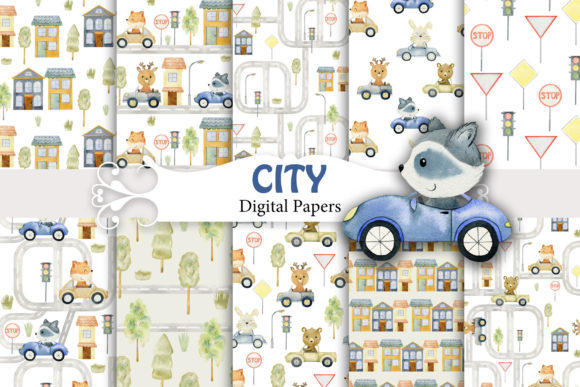
Imagine a vintage sedan rendered in soft, bleeding cobalt washes—its curves blurred by gentle pigment diffusion—nestled beside a watercolor fox wearing tiny goggles. Or a skyline where skyscrapers dissolve into granulated sepia, punctuated by miniature cars with rabbit ears or owl headlights. That’s the quiet magic of Watercolor Patterns with Cars: a cohesive, hand-painted digital kit that merges automotive charm with organic texture and playful storytelling.
This isn’t clipart. It’s not vector repetition disguised as art. These are 10 original, high-resolution JPEGs—each 16×16 inches at 300 DPI—designed from the ground up for real-world versatility. Every pattern is seamless, meaning you can repeat it horizontally and vertically without visible breaks. Tile one across a 48×72-inch fabric roll, stretch it across a website hero section, or shrink it to frame a baby onesie pocket—all without distortion or mismatched edges.
Why Seamless Watercolor Patterns Stand Apart
Most digital paper packs sacrifice authenticity for convenience. They’re either overly rigid (geometric repeats) or too loose (non-tileable illustrations). Watercolor Patterns with Cars bridges that gap. Each design balances spontaneity and structure: pigment blooms feel natural, but alignment points are precisely calibrated. The result? You get the warmth of hand-painted imperfection—granulation, subtle lifts, soft halos around shapes—without sacrificing technical reliability.
The palette leans into muted, earthy tones—ochre, slate blue, dusty rose, olive green—with intentional pops of saturated coral or mustard where animal-car hybrids appear. This makes them easy to pair with photography, typography, or solid-color branding. Unlike high-contrast digital patterns, these recede gracefully as backgrounds, letting text or product imagery stay legible and prominent.
Where These Patterns Actually Get Used
Creatives don’t buy patterns—they solve problems. Here’s how professionals apply Watercolor Patterns with Cars day to day:
- Scrapbookers & Journal Keepers: Print on cardstock or vellum for layered page backgrounds. The subtle texture adds depth under photos without competing visually. Animal-car motifs spark narrative prompts—“What adventure did this raccoon-driven pickup truck just finish?”
- Web & App Designers: Use tiled patterns as CSS background images for section dividers, newsletter headers, or dashboard accents. Because they’re seamless and 300 DPI, they scale crisply on Retina displays—and compress well for fast loading when optimized.
- Small-Batch Apparel Makers: Apply directly to fabric printers for limited-run tees, tote bags, or baby rompers. The watercolor bleed mimics traditional screen-print softness, while the car-animal characters add whimsy without looking juvenile.
- Educators & Therapists: Print full-sheet patterns for visual schedules, emotion cards, or sensory bins. A child identifying “the turtle in the convertible” practices observation, vocabulary, and emotional association simultaneously.
- Publishers & Indie Authors: Integrate into book interiors as chapter dividers or endpapers. The cityscapes with embedded cars lend narrative cohesion to middle-grade fiction or urban-themed poetry collections.
Real Benefits Beyond Aesthetics
Time savings matter. With standard scrapbook papers, scaling a motif to cover an A3 poster means stitching multiple scans—or risking pixelation. Here, one file does it all. No resizing artifacts. No seam-hunting in Photoshop. Just drag, tile, and export.
Branding consistency improves, too. If your business uses soft watercolor textures elsewhere (say, logo treatments or social banners), adding these patterns creates visual continuity—without forcing identical color schemes. The cars and animals act as subtle, ownable motifs you can reference across touchpoints.
And because each JPEG is delivered at print-ready resolution, there’s no guesswork about output quality. Whether you’re ordering custom stationery through Moo or printing fabric via Spoonflower, the files meet industry specs out of the box.
Practical Considerations Before You Use Them
Not every use case benefits equally from watercolor texture. Avoid pairing these patterns with ultra-thin fonts or low-contrast text overlays—those will lose legibility. Instead, use bold sans-serifs or letterpress-style type with generous spacing.
If you’re designing for accessibility, test contrast ratios. While the base washes are light, darker car silhouettes and animal details usually provide enough separation for WCAG AA compliance—but always verify using tools like Stark or axe DevTools.
For apparel, keep in mind that fabric printing processes vary. Test a small swatch first, especially on textured materials like linen or terry cloth, where pigment absorption may mute fine details. The animal-car hybrids hold up best on smooth cotton or polyester blends.
More Than Just Backgrounds—They Invite Interaction
One unexpected strength of Watercolor Patterns with Cars is its narrative flexibility. A pattern showing a city skyline with cats driving double-decker buses doesn’t just decorate—it invites interpretation. Teachers use it to launch discussions about urban ecosystems. Marketers build micro-stories around each vehicle (“Meet Luna—the squirrel who delivers local honey by Vespa”). Even developers embed them into interactive prototypes, using hover states to reveal hidden animal names or sound effects.
That interactivity starts with intentionality in the artwork itself. Notice how shadows fall consistently across elements, how horizon lines align across tiles, and how animal features integrate organically—not pasted on, but part of the composition’s logic. That level of craft turns passive decoration into active engagement.
If you’ve ever struggled to find patterns that feel handmade yet functionally robust, or wanted to add personality to a project without leaning into cliché, Watercolor Patterns with Cars offers something rare: cohesion without rigidity, playfulness without noise, and professionalism rooted in tactile authenticity.
Need help choosing which pattern suits your project? Have questions about licensing for commercial resale or bulk fabric orders? Just send a message—we’re happy to clarify usage rights, suggest pairings, or share tips for specific platforms like Canva, Adobe Express, or Cricut Design Space.