Seamless Patterns with Cute Foxes
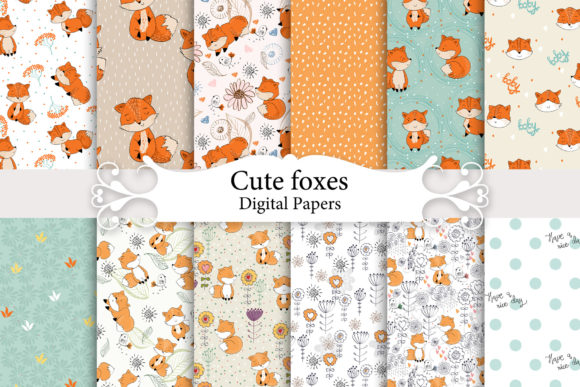
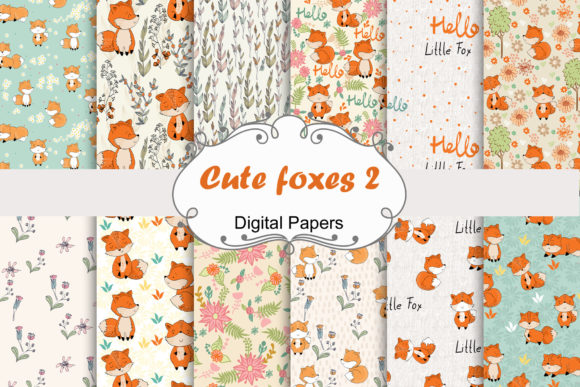
Seamless Patterns with Cute Foxes is a curated digital paper kit designed for creators who need high-fidelity, repeatable surface designs without compromising charm or technical integrity. Unlike decorative clipart or isolated illustrations, this collection delivers twelve fully tiled, resolution-robust JPEG files—each 4800×4800 pixels at 300 DPI, equivalent to 16×16 inches when printed. The patterns feature stylized, friendly fox motifs arranged in balanced, non-repeating rhythm across the canvas—ensuring clean edge alignment and invisible joins when repeated horizontally or vertically.
What Makes These Patterns Actually Seamless—and Why That Matters
“Seamless” isn’t just marketing language here. Each of the twelve patterns was constructed using precise offset tiling techniques in professional raster editing software, then verified visually and technically across multiple tile repetitions. This means you can place one image directly adjacent to itself—left, right, up, down—or layer it across large-format prints without visible seams, misaligned elements, or pixelated breaks. For context: many “seamless” digital papers on marketplaces fail under real-world use—especially when scaled beyond standard 8.5×11 inch layouts or applied to curved surfaces like tote bags or ceramic mugs. Seamless Patterns with Cute Foxes avoids that pitfall by prioritizing structural consistency over decorative density.
The fox illustrations themselves are drawn with soft outlines, gentle color palettes (think muted terracottas, sage greens, warm creams, and slate blues), and consistent line weight. They avoid excessive detail that could break down at small scales or bleed unpredictably during screen printing. That restraint supports versatility: a single pattern works equally well as a subtle background for a baby onesie label, a bold repeat for wallpaper mockups, or a layered texture beneath hand-lettered typography in a greeting card design.
Practical Use Cases Across Creative Workflows
This kit serves professionals whose output spans both digital and physical mediums. A freelance surface pattern designer might use these files as starting references for developing original motifs—studying spacing, scale hierarchy, and negative space distribution before committing to custom illustration. A small-batch apparel brand owner can import a pattern directly into Adobe Illustrator’s Pattern Options panel to generate swatches for fabric sampling, or drop it into a print-on-demand platform’s template with confidence that tile boundaries won’t disrupt garment seams.
Educators teaching textile or graphic design principles may use the set to demonstrate tiling mechanics, DPI implications for print vs. web, or how motif repetition affects perceived texture and rhythm. Bloggers creating themed printable planners or journal kits benefit from having ready-to-use, copyright-cleared backgrounds that maintain visual cohesion across multiple pages—no need to manually stitch or resize assets.
Scrapbookers and stationery designers appreciate the balance between cuteness and clarity: the foxes read clearly at thumbnail size but retain enough nuance to hold interest at full print resolution. Unlike overly simplified vector icons or cartoonish PNGs, these patterns function as true *surfaces*—they support layering, transparency adjustments, and color overlays without losing structural integrity.
Quality Benchmarks and Real-World Performance
All twelve JPEGs meet commercial-grade production standards. At 4800×4800 px, they accommodate large-scale outputs: wall murals, fabric yardage, packaging wraps, and even billboard mockups (when used in appropriate context). The 300 DPI resolution ensures sharpness for offset and digital printing—critical for boutique paper goods or premium baby clothing lines where tactile quality influences perceived value.
File naming is logical and consistent (e.g., CuteFoxes2_Pattern07_FoxAndBerries.jpg), aiding organization in asset libraries or DAM systems. No hidden layers, embedded fonts, or proprietary formats—just flat, universally compatible JPEGs. That simplicity reduces friction in collaborative environments where team members use different software stacks (Affinity, Procreate, Photoshop, Canva Pro, etc.).
One practical note: because these are raster-based—not vector—the patterns aren’t infinitely scalable *beyond* their native dimensions without interpolation artifacts. For projects requiring extreme enlargement (e.g., architectural-scale murals), users should test output at intended viewing distance first. But for 95% of common applications—including apparel up to adult XL, A4/A3 stationery, and social media banners—the resolution holds cleanly.
Audience Fit: Who Benefits Most—and When
Seamless Patterns with Cute Foxes suits creators who value efficiency without sacrificing aesthetic control. It’s especially relevant for:
- Small business owners launching lifestyle brands—particularly those focused on children’s products, nature-themed wellness, or handmade goods—where cohesive, ownable visuals help differentiate in crowded markets;
- Freelance designers building client-facing mood boards or pitch decks, where time spent sourcing and testing patterns detracts from strategic work;
- Digital educators and course creators producing downloadable resources—planners, worksheets, or lesson kits—that require consistent, non-distracting backgrounds;
- Print-on-demand sellers needing reliable, license-cleared repeats for platforms like Redbubble, Spoonflower, or Printful, where upload errors or tile misalignment often trigger rejection;
- Hobbyists pursuing high-quality personal projects, such as custom wedding invitations, memory books, or nursery decor—where emotional resonance matters as much as technical execution.
It’s less suited for users requiring editable source files (e.g., layered PSDs or AI vectors), photorealistic rendering, or culturally specific iconography. The fox motif carries universal appeal but doesn’t attempt thematic depth—so it won’t serve niche narratives like Indigenous storytelling or scientific illustration.
Long-Term Value and Integration Considerations
Because the patterns are resolution-agnostic in terms of tiling logic—and built using neutral, adaptable color harmonies—they age well. Unlike trend-dependent palettes (e.g., neon gradients or hyper-saturated pastels), the tones in Seamless Patterns with Cute Foxes align with enduring design sensibilities: warmth without cloying sweetness, playfulness without immaturity. That makes them reusable across product lines and seasons without feeling dated.
Integration into existing workflows is straightforward. Designers using Figma or Sketch can drag-and-drop JPEGs as fills; those in Affinity Designer can convert them to repeating swatches in seconds. For print production, embedding the files directly into PDF/X-4 compliant documents preserves fidelity. No special plugins, subscriptions, or font dependencies are required.
If you’re evaluating whether Seamless Patterns with Cute Foxes fits your current project, ask two questions: Does the visual tone match your audience’s expectations? And do you need repeatable, production-ready surfaces—not just isolated graphics? If both answers are yes, the kit delivers measurable time savings, reduced revision cycles, and consistent output quality. As with any digital asset, review licensing terms carefully—but within its stated scope, Seamless Patterns with Cute Foxes performs reliably, predictably, and professionally.