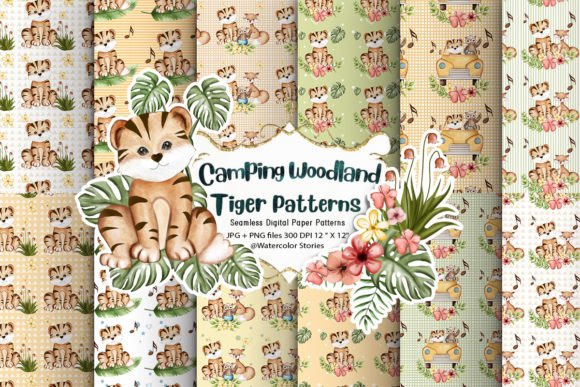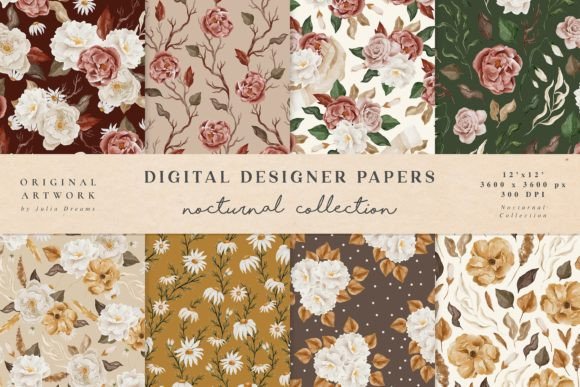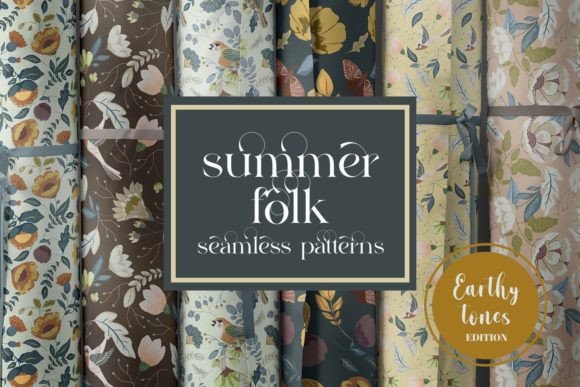
Woodland Seamless Patterns
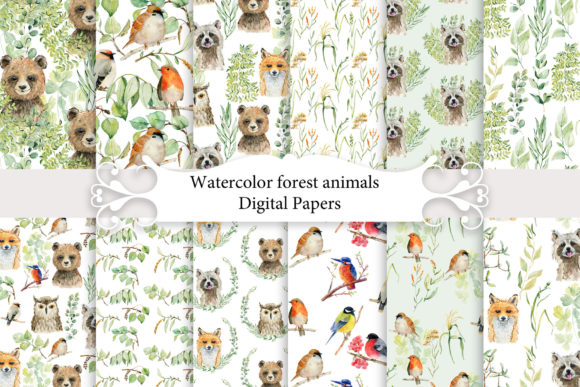
Woodland Seamless Patterns is a focused digital asset kit built for creators who need versatile, nature-inspired background textures without the hassle of manual tiling or resolution compromises. It consists of 12 high-resolution JPEG files—each 12 by 12 inches at 300 DPI—featuring hand-crafted digital watercolor papers with integrated woodland animal motifs: foxes, deer, owls, hedgehogs, rabbits, and squirrels rendered in soft, organic strokes and muted natural palettes. Unlike generic clipart or mass-produced vector repeats, these patterns are designed from the ground up as true seamless tiles: edges align precisely so adjacent copies blend invisibly, whether scaled across a full-page journal spread or repeated across fabric yardage.
What Makes These Patterns Functionally Distinct
The core strength of Woodland Seamless Patterns lies in its dual-layered design philosophy: aesthetic cohesion and technical reliability. Each pattern balances illustrative detail with intentional negative space—enough visual interest to hold attention, but not so dense that it overwhelms text overlays or printed garments. The digital watercolor texture adds subtle grain and variation, avoiding the flatness common in vector-based repeats. This gives printed outputs—especially on matte paper or natural-fiber fabrics—a tactile, artisanal quality that photographs well and translates consistently across devices.
Because all 12 files are delivered as JPEGs at print-ready resolution, users avoid compatibility friction. There’s no need for software-specific plugins, layers, or color profile conversions. Designers using Affinity Publisher, Canva Pro, Adobe InDesign, or even free tools like GIMP can import and tile them directly. The 300 DPI specification ensures crisp output for physical products: baby onesies, greeting cards, gift wrap, or handmade stationery retain fidelity when printed through services like Printful, MOO, or local print shops.
Real-World Usability Across Creative Workflows
In practice, Woodland Seamless Patterns performs reliably where many decorative assets falter: scalability without pixelation, adaptability across mediums, and consistent tone across the set. A graphic designer creating a brand identity for an eco-conscious children’s book publisher used three patterns—one with ferns and foxes, another with mushrooms and owls, and a third with acorns and hedgehogs—to unify cover art, chapter dividers, and interior page backgrounds. Because each tile repeats seamlessly, they extended patterns across bleed areas without visible seams or distortion.
Similarly, a small-batch apparel entrepreneur applied one of the deer-and-moss patterns to a limited-run line of organic cotton rompers. Using a repeat swatch in her print-on-demand dashboard, she scaled the tile to fit standard garment widths. The watercolor texture softened the repetition visually, making the pattern feel custom rather than mass-produced. No test prints were needed—the alignment held across six different garment sizes, confirming the precision of the edge matching.
Journaling and scrapbooking users benefit from the 12×12 inch size, which matches standard digital scrapbook paper dimensions. When layered beneath photos or handwritten notes, the patterns provide gentle visual framing without competing for attention. Educators have repurposed them as printable classroom resources—forest-themed worksheets, reading logs, or bulletin board backdrops—where the cohesive palette supports focus and reduces visual fatigue.
Who Benefits Most—and Where It Fits (and Doesn’t)
Woodland Seamless Patterns serves professionals and serious hobbyists whose work relies on consistent, nature-aligned visual language—not just surface-level “cuteness.” It’s especially effective for those building long-term brands or product lines where tone, texture, and thematic continuity matter: sustainable lifestyle bloggers, indie stationery makers, Montessori-aligned educators, botanical illustrators developing companion assets, or wedding designers curating woodland-themed invitations and signage.
It’s less suited for projects demanding extreme customization—such as altering individual animal elements or recoloring specific motifs—since the JPEG format locks in composition and color balance. Users needing editable vectors or layered PSD files would need to supplement with additional tools or services. Likewise, those working exclusively in low-resolution digital contexts—like social media banners under 1080px width—won’t fully leverage the 300 DPI advantage, though the files still scale down cleanly.
The kit also assumes baseline familiarity with tiling workflows. While straightforward in most design applications, first-time users may need to consult their software’s documentation on pattern fill or repeat settings—particularly in web design environments where CSS background-repeat requires correct image sizing and offset handling. That said, the seamless nature eliminates guesswork around alignment; once imported, the tile behaves predictably.
Quality, Consistency, and Long-Term Value
All 12 patterns maintain consistent color grading, line weight, and compositional density. There’s no abrupt shift in style between, say, the rabbit-and-mushroom design and the owl-and-branch variant—no jarring contrast in saturation or brushstroke intensity. This uniformity saves time during selection and assembly. Rather than auditioning dozens of mismatched assets, users can mix and match within the set knowing tonal harmony is already resolved.
The digital watercolor treatment contributes meaningfully to longevity. Unlike trend-driven illustrations that age quickly, the muted earth tones and organic texture resist obsolescence. These patterns remain relevant across seasons and years—not as novelty graphics, but as foundational design elements. For small business owners producing seasonal collections, that means reusing base patterns across spring baby clothes, autumn stationery, and winter gift wrap without visual whiplash.
From a file management perspective, the kit avoids bloat: 12 clean JPEGs, clearly named (e.g., “woodland-fox-ferns-seamless.jpg”), require minimal storage and load efficiently into cloud-based design tools. No extraneous folders, license documents, or redundant formats clutter the workflow—just the assets, ready for immediate use.
Practical Integration Tips
- For web designers: Use CSS
background-repeat: repeat;with the original 12×12 inch file. At 300 DPI, it scales crisply even on high-density displays when embedded via modern image-loading techniques. - For print production: Confirm your printer’s preferred color profile (usually sRGB for digital labs, CMYK for offset). These files ship in sRGB—ideal for most POD platforms—but convert only if explicitly required by your vendor.
- For apparel and fabric: Test a small swatch first. Natural fibers absorb ink differently than synthetics, and the watercolor grain may read more softly on linen or bamboo blends—often an advantage, but worth verifying.
- For educators and journalers: Import into note-taking apps like GoodNotes or Notion as PDF backgrounds. The resolution supports zooming without blur, preserving legibility even at 200% magnification.
If you’re evaluating whether Woodland Seamless Patterns fits your current or upcoming project, consider this: does your work benefit from quiet, grounded visual rhythm—rather than loud, isolated icons? Do you value assets that behave the same way across screen and paper, without requiring post-processing to “fix” alignment or resolution? If yes, this kit delivers measurable efficiency and aesthetic consistency, not just decorative variety. It’s a tool that works quietly in the background—supporting your message, not competing with it.